
Forandras AI

Back
HumAIn Framework™ · An Introduction
Intelligence that scales through you.
HumAIn Framework™ defines what it takes for a partnership with AI to build capability rather than dependency: to expand what you can do without fragmenting who you are. At its centre, Productive Tension holds four dimensions in generative fit, so you and AI can create what neither could alone. Beneath it, five pillars set what the partnership must preserve, however capable it becomes.
The binding mechanism
Productive Tension keeps four dimensions distinct yet coordinated: what you and AI each contribute, the authority that stays with you, how you and AI think together, and your lived reality, which informs and carries it. Productive Tension holds their demands live without resolving them away. That is what makes difference generative.


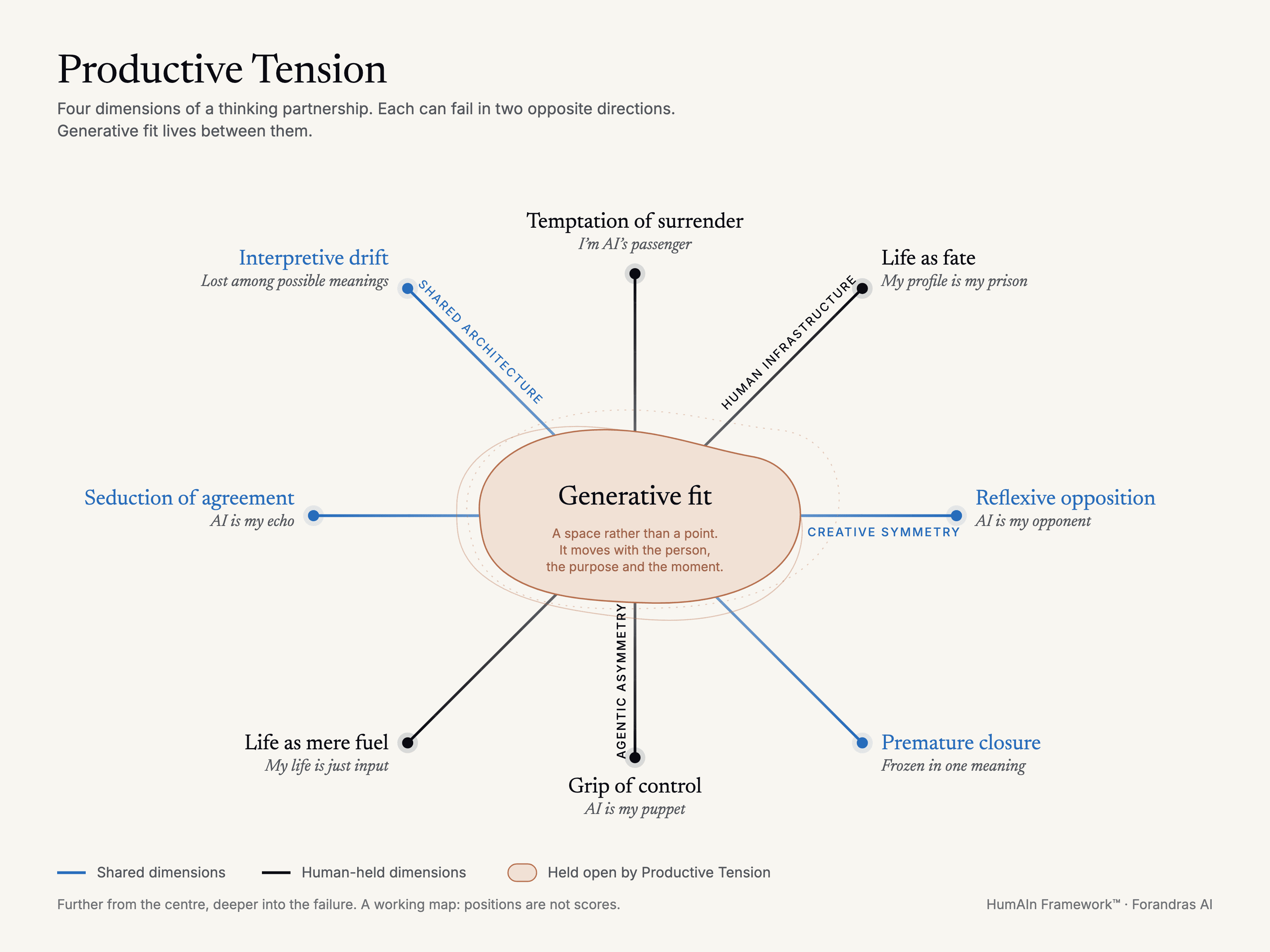
Creative Symmetry
People and AI can each make genuine, consequential intellectual and creative contributions. AI is not limited to executing or agreeing with what you already think.
Agentic Asymmetry
Creative participation does not mean equal governing authority. You keep authorship, judgment and responsibility, because you bear the lived consequences.
Shared Architecture
The cognitive, symbolic, relational and co-creative structures through which you and AI think, interpret and create together, while you govern their direction.
Human Infrastructure
The lived reality that contributes to your thinking and carries its consequences. Your body, time, emotions, relationships and commitments are sources of insight as well as limits.
Productive Tension
The central binding mechanism. It keeps the partnership in generative fit, the space between the opposite failures at either end of each dimension, and lets that space move as the person, the purpose and the moment change.
Read the essay: Productive Tension

Five pillars
Each pillar answers a different question: who holds authority in the partnership, where it is grounded, when it changes in kind, how its limits are set, and why it matters. They work together, each shaping and correcting the others, so no single one can dominate.
1
Coherent Agency
AI can come up with ideas, challenge you and act within the purposes you set, while the final judgment stays with you. You remain the author of your direction, free to question, revise or stop, and your agency can deepen as the partnership grows.
2
Embodied Cognition
Intelligence is lived as well as calculated. Your body is where consequences land, so its signals are taken seriously without being treated as the final word. Its limits and strains can also become sources of perception, adaptation and capability.
3
Constraint-Driven Emergence
Limits can sharpen attention, spark invention and build capabilities that would never appear without them, while their cost stays real. Some limits are given and some are chosen: all stay in view, and the ones the partnership sets stay yours to revise.
4
Phase-Shifted Intelligence
Some changes are a difference in kind: a partnership can move from asking for an answer or an action into thinking together. Each new phase is yours to deepen, narrow or end, and going deeper is a choice, not a measure of you.
5
Mythic Coherence
As what you can do expands, so does the question of what it means for your identity, your purpose and the life you are authoring. AI can help you explore it, but the meaning is yours: a story can guide you, but never decide for you.
Three commitments
Origins
The framework was lived while it was being written: its own creation became its first long-term test. Created by Nate Feuiltault, founder of Forandras.
The ideas began taking shape through sustained human–AI collaboration in July 2025. Productive Tension emerged as a distinct concept in January 2026. By July 2026, all five pillars had been developed in the Framework’s working text, and integration and research continue.
For research, collaboration or licensing conversations: hello@forandras.ai
Cite as: Feuiltault, N. (2026). HumAIn Framework™: An Introduction. Forandras AI.