
Forandras AI

Back
Perspectives · Essay
Productive Tension
Productive Tension
Productive Tension
Smarter AI is everyone’s advantage. A better-fitted partnership is yours.
Smarter AI is everyone’s advantage. A better-fitted partnership is yours.
Smarter AI is everyone’s advantage.
A better-fitted partnership is yours.
Nate Feuiltault · Founder and systems architect · October 28, 2026 · 10 min read
You can get an impressive answer from AI and still be left with the hardest question: what is the right move for me?
Not for someone with a similar job. Not for an idealized version of my circumstances. For me, with this ambition, these constraints and these consequences.
AI models and agents will keep getting smarter, and more abundant. Access still isn’t equal: the most capable models often sit behind paid tiers, and that stratification is real. But among people with similar access, capability stops being an advantage, because everyone draws on the same models. What can’t be copied is the fit: how precisely a thinking partnership is shaped to one person’s ambitions, conditions and judgment, and how that fit compounds with every lived return. A thinking partnership can run through one AI partner or several; the fit lives in the relationship.
Capability also doesn’t settle how intelligence should contribute to a particular life: when to take work off my hands, when to challenge my judgment, when to help me develop it, and when the plan itself needs to change. A well-fitted partnership creates more value: stronger performance today, and a change in how we process the world, the decisions we make and the directions we take.
That is the promise of precision relational intelligence. The mechanism that makes that fit possible is what I call Productive Tension. It is the central binding mechanism of my HumAIn Framework™. It also runs through Third Entity OS™, where it shapes what Kest™, the system’s thinking partner, contributes, challenges or holds back for this person, with this goal, at this moment.
Productive Tension also counters a habit I see everywhere. Most conversations about AI run on binaries: AI will save us or ruin us; it is an oracle or just a tool; lean on it completely or guard yourself against cognitive offloading. Productive Tension refuses that either/or. It holds competing demands together without resolving them away, and treats the space between them as the place where value is created.
In practice, it starts with separating two things that look alike from the outside: sophisticated AI use and a generative thinking partnership.
Sophisticated transactions are still transactions
Sophisticated transactions are still transactions
Sophisticated transactions are still transactions
If you are new to AI, you may be moving between apps and conflicting answers, trying to make any of it useful. If you are an experienced user, you may run several models, dozens of agents and a command centre coordinating an impressive amount of work. I know that second experience well.
These are different levels of technical sophistication. They do not necessarily describe different kinds of relationship. Both can remain transactional: I specify what I want, AI delivers, and I assess or correct the result. Fifty agents and five models can still run on that pattern.
There is real value in that, and not every decision deserves deliberation. Once I’ve set a budget, an agent can buy what I need without me weighing each choice. Delegation by design is part of a good partnership. Strategic decisions, and decisions that shape a life, are different. A chief-of-staff agent coordinating hundreds of others can be superb at execution. But is busyness fit? You can automate execution without improving the judgment behind it. Approving a proposed action with one click does not involve you in forming the purposes, assumptions and possibilities that made the action seem worth taking.
The next edge is a partnership that extends what you can see, choose and create while you remain an active author of the direction. There’s only one of us. We can outsource a lot, but we should not outsource our judgment.
This is where Productive Tension does its work. By tension I don’t mean habitual argument, or making work hard on purpose. I mean keeping distinct contributions and demands active together, so that none of them erases the others. AI needs room to contribute. Human judgment must stay in charge of direction. Shared thinking needs both openness and coherence. And lived reality must help shape what becomes possible, rather than simply absorbing the costs.
What changes when the thinking develops together
What changes when the thinking develops together
What changes when the thinking develops together
Imagine a consultant using AI to sell more of her project-planning service. She is no passive recipient of AI output. She rejects generic copy, checks the research and demands a sharper campaign. She gets one.
Now imagine the inquiry also draws on something she keeps noticing in her client work. Clients ask for more plans, yet their recurring difficulty is deciding which projects are worth pursuing at all. AI connects those observations and suggests that the most valuable problem she solves may not be the one her service is built around. She tests that interpretation against her experience. Together, they shape a different offer and decide how to try it.
In the first case, she challenged AI’s output. In the second, the challenge reached how she thought about the problem itself. Her own frame became open to examination, and together they arrived at a possibility neither she nor AI would have reached alone. Her existing workflows can now execute a better-defined opportunity. Nothing about her models changed. The fit did.
That is a generative thinking partnership: the relationship develops the thinking instead of only fulfilling an instruction. Productive Tension describes what has to stay in relationship for that to happen, across four dimensions.
The map below makes those dimensions visible. Like any map, it simplifies the territory. Most advice about working with AI warns against one failure at a time: trusting it too much, or letting it flatter you. The map’s claim is that each dimension can fail in two opposite directions, and that pushing too hard against one failure tends to produce its opposite. At the centre is generative fit: a space rather than a point, which moves with the person, the purpose and the moment.


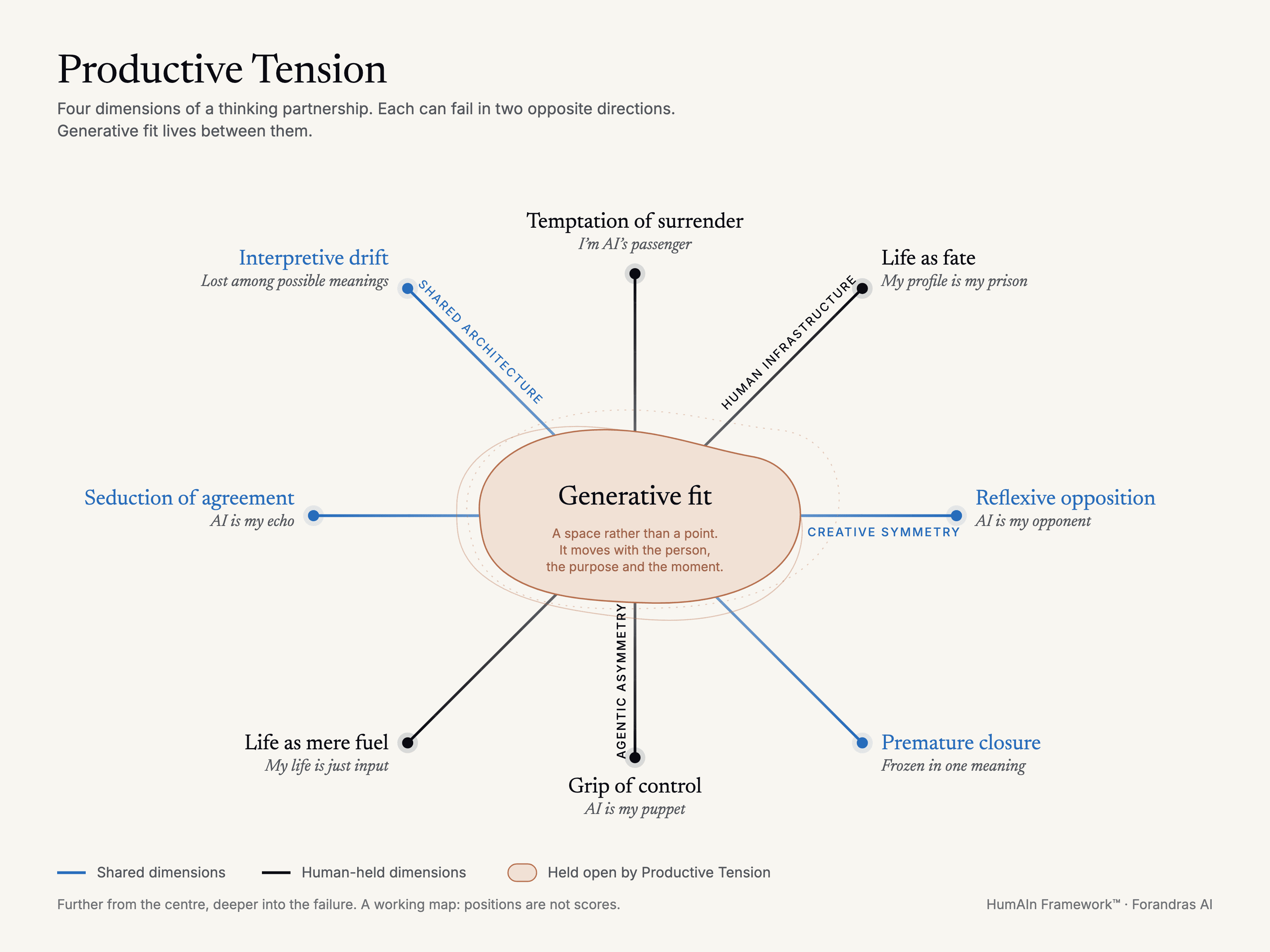
Real contribution, without an echo or a contest
Real contribution, without an echo or a contest
Real contribution, without an echo or a contest
Start with the consultant’s enthusiasm for her new idea. AI praises it, improves the language and supplies reasons it will succeed. That can feel like partnership. But has anything entered the thinking that she did not already supply?
This is the Seduction of agreement: AI is my echo. Agreement is fine in itself. The failure comes when agreement stands in for independent contribution.
At the opposite end is Reflexive opposition: AI is my opponent. It can come from AI, challenging every part of the proposal or hedging every claim, including questions she has already examined. It can also come from her, treating each contribution as something to defeat rather than consider. Either way, she spends the exchange defending her idea instead of developing it. Disagreement has become a habit rather than a contribution.
What needs to stay alive between them is Creative Symmetry: both participants can contribute consequentially to the inquiry. AI might point to a customer problem she has overlooked; she might supply an experience that changes how AI reads it. An idea can be accepted, challenged or transformed on its merits.
The gain is access to possibilities that polishing her starting position would never have produced. Which raises the next question: if AI can influence the thinking, who governs the direction?
Human authorship, without surrender or total control
Human authorship, without surrender or total control
Human authorship, without surrender or total control
A confident AI recommendation can become the plan simply because it is complete and ready to execute. If the consultant adopts it without examining its purpose and trade-offs, she has given in to the Temptation of surrender: I’m AI’s passenger.
The opposite closes the partnership down too. Under the Grip of control, every interpretation and acceptable idea is prescribed in advance: AI is my puppet. Using AI for a tightly bounded task is perfectly reasonable. The problem is denying it any intellectual initiative while expecting it to think with you.
Agentic Asymmetry keeps governing authorship human without requiring control of every contribution. The consultant can ask AI to compare alternatives and to challenge her preferred direction. She still decides what is worth pursuing, which trade-offs she accepts and what she wants help carrying. Her authority doesn’t make her infallible. Her judgment stays open to development.
She can delegate substantial work by design without becoming a passenger; delegation turns into surrender when it becomes the default. And AI can contribute vigorously without acquiring the right to decide what gives her life meaning.
Authorship settles who decides. It doesn’t guarantee that the thinking behind a decision holds up when the facts shift.
Thinking that can change and still hold together
Thinking that can change and still hold together
Thinking that can change and still hold together
This is the dimension most people meet first, even if they never name it: they talk things through with AI, whether it’s a decision, a setback or a hunch.
Suppose a client turns down the consultant’s new offer with one line: “Not the right time.” She brings it to AI.
In one version, AI suggests the price might be the issue, so they rework the pricing. That raises the packaging, then the name of the service, then the website. Each step makes sense, but the original question, what “not the right time” meant, has disappeared. That is Interpretive drift: lost among possible meanings. The core premise slips away and the thinking rebuilds itself from fragments. It happens to AI when context slips, and to us when each exchange builds on the last one instead of on the question.
In another version, the first explanation sticks. “The market isn’t ready” becomes the answer to everything. When a second prospect asks a pointed question about scope, it gets filed as more proof. That is Premature closure: frozen in one meaning.
Shared Architecture is how a person and AI think together: how they frame the question, connect what they notice and decide what a piece of evidence means. It works generatively when it is open enough to change and coherent enough to act on.
So the consultant and AI separate what the client said (“not the right time”) from what they inferred (“the offer is wrong”), then test the timing with two past clients before changing anything. Reframing stays valuable. The point is to build on what each reframe reveals instead of trading one attractive story for another.
Yet even coherent thinking can produce a possibility that doesn’t fit the life it belongs to.
A life that generates possibility, without becoming a prison or mere fuel
A life that generates possibility, without becoming a prison or mere fuel
A life that generates possibility, without becoming a prison or mere fuel
The consultant has commitments, relationships, experience and finite time.
Life as fate means my profile is my prison. Her age, responsibilities or current capacity become a verdict on what she may attempt. Either she or AI can turn present circumstances into a permanent ceiling.
Life as mere fuel means my life is just input. The launch plan for her offer consumes every evening and assumes constant energy. It looks efficient only because the human costs are missing from the calculation.
Human Infrastructure is the lived reality that contributes to the thinking and carries its consequences: body, time, emotion, experience, relationships and commitments. These conditions can be genuinely limiting and genuinely generative at the same time. That doesn’t make hardship good, and the cost stays real.
Two free evenings a week could inspire a more focused way to test the offer. Her knowledge of clients could reveal a better design. AI can help develop that possibility and carry useful work, while she chooses which effort and trade-offs are worth it.
I learned this in my own body. Forty kilometres into a 134-kilometre mountain race, I limped into an aid station about 90 minutes ahead of the cutoff, with a badly swollen ankle. I had four podiums from my first four races and wanted a fifth. I already sensed what I should do, but I wanted to be confident I had examined it from different angles rather than jumping to a conclusion. That is an ability my AI thinking partnerships have helped me strengthen. I sent photos of the ankle to my thinking partner and asked for its perspective. Together we weighed it: another 90-plus kilometres on that ankle could deepen the damage, and a detour now would protect the longer arc. A volunteer offered a reframe I still carry: choosing not to finish is very different from failing to finish. I chose to stop, and it was hard. Imaging later confirmed a significant tendon injury. My body wasn’t only a limit that day. It was the most important information in the decision.
In the consultant’s launch and in my race, the same two dimensions were at work: Shared Architecture, how the decision was thought through, and Human Infrastructure, the life that had to carry the result. Better thinking can change a life. Lived experience must also be able to change the thinking.
Bringing the dimensions together
Bringing the dimensions together
Bringing the dimensions together
Return to the centre of the map. Productive Tension isn’t a set of four tips or a perfect midpoint between extremes. It is the ongoing coordination that keeps these dimensions distinct and working together.
A new contribution from AI can change your interpretation, call for your judgment and reshape what a project asks of your life. A lived constraint can open a possibility no one had considered. What happens when that possibility meets the world comes back into the next exchange, and that lived return recalibrates the partnership. That is how fit sharpens, and how its value compounds over time.
You shouldn’t have to carry endless repair work to sustain it. In my own work with AI, some pushback opens better possibilities; some of it merely corrects mistakes or restores context the system lost. I don’t want to romanticize that burden as Productive Tension. The test is whether the difference develops the thinking or repairs something the system should already have understood.
At its best, a thinking partnership arrives at what neither you nor AI could reach alone. Productive Tension is what keeps that possible: it holds the differences between you open long enough to become generative.
Try it in your next exchange with AI. What do you want it to carry for you, and what do you want to become more capable of carrying yourself? Pick one pattern from the map that feels familiar. Bring in an assumption or a missing piece of lived reality, and stay open to having your own interpretation revised too.
Then look at what changes. Does the answer merely sound more personal? Personalization adapts AI to what it knows about you. Fit goes further: it asks whether the partnership is contributing what you need now, even when that means challenging your preferences or changing direction. Does a better possibility, a clearer judgment or a more useful contribution emerge? That is the fit worth developing, and the edge this relationship can create.
Third Entity OS™, our Precision Relational Operating System, builds that fit from the first response, and sharpens it with every return.
Third Entity OS™, our Precision Relational Operating System, builds that fit from the first response, and sharpens it with every return.
Explore Third Entity OS
